Tree trimming and cutting services sit at the intersection of practical necessity and long-term stewardship, a point that is easy to miss when the only visible outcome is a cleaner canopy and a pile of chipped wood at the kerb. But the work runs deeper than appearances suggest. Trees, particularly in dense urban environments, are living infrastructure. They cool streets, absorb rainfall, filter particulates, and anchor soil. How they are maintained determines, in large part, how well they perform those functions over time.
What Tree Trimming and Cutting Services Actually Cover
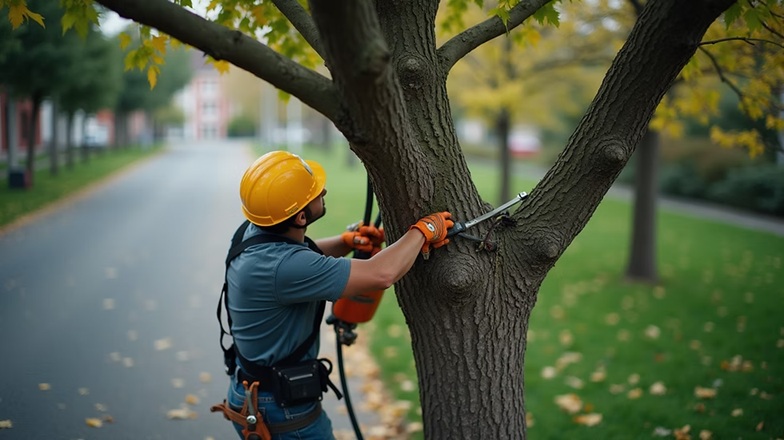
The phrase gets used loosely, but professional tree trimming and cutting encompasses a range of distinct operations, each suited to different objectives and conditions.
Crown thinning removes selected branches throughout the canopy to improve light penetration and air circulation without altering the overall shape of the tree. It is particularly valuable for trees that have grown dense over many years and are beginning to show signs of internal dieback.
Crown lifting raises the lower boundary of the canopy by removing the lowest branches. This is common along roadsides and pedestrian paths, where clearance for vehicles and people is a practical requirement rather than an aesthetic preference.
Crown reduction decreases the overall height or spread of a tree, typically to manage its relationship with nearby structures or utilities. When carried out correctly, it preserves the natural form of the tree. When done badly, it produces the disfigured stubs that arborists refer to as topping, a practice that creates structural weakness and long-term health problems.
Tree cutting services in the fuller sense extend to the removal of dead or structurally compromised trees, the management of storm-damaged specimens, and the clearing of land where development or landscaping is planned. Each of these tasks demands a different combination of skill, equipment, and risk assessment.
The Maintenance Benefits of Regular Tree Trimming
Structural Integrity Over Time
One of the most persuasive arguments for scheduled tree trimming services is the effect on long-term structural health. Trees that are never pruned tend to develop competing leaders, branches of roughly equal size that grow upward in parallel and create weak, included bark unions at their junctions. These unions are the fracture points that give way during storms.
Regular trimming, carried out by a qualified arborist from the early years of a tree’s life, shapes the architecture of the canopy in ways that reduce this vulnerability. The investment is modest relative to the cost of emergency tree cutting after a limb failure has damaged a roof or blocked a road.
Disease and Pest Management
Pruning removes dead, dying, and diseased wood before problems can spread. In Singapore, where the tropical climate creates ideal conditions for fungal pathogens and wood-boring insects, this preventive dimension of tree trimming and cutting carries particular weight. The National Parks Board (NParks) has documented cases where early intervention through targeted pruning has extended the life of trees that would otherwise have required full removal within a few seasons.
Wounds created by pruning also heal more effectively when cuts are made cleanly and at the correct angle, just outside the branch collar where the tree’s natural defence chemistry is concentrated. This is not a detail that amateur trimming reliably gets right.
Managing Growth Near Infrastructure
Roots and canopies do not recognise property boundaries or utility easements. Left unmanaged, branches encroach on neighbouring structures, interfere with overhead cables, and shade out solar panels. Root systems lift pavements, infiltrate drainage pipes, and undermine shallow foundations.
Regular tree trimming and cutting services address the canopy side of this equation systematically, removing growth before it reaches the point of conflict. This is less costly and less ecologically disruptive than reactive removal once a tree has grown into a problem.
Benefits of routine maintenance in urban settings include:
- Reduced risk of branch failure during high winds or storms
- Maintained clearance for roads, pathways, and utilities
- Improved light and ventilation for surrounding buildings and garden spaces
- Lower likelihood of requiring full tree removal in the future
- Extended functional lifespan of mature specimens
Singapore’s Approach to Urban Tree Maintenance
Singapore manages one of the most intensively maintained urban forests in the world, with NParks overseeing more than two million trees across roads, parks, and nature reserves. The system relies on regular inspections and a tiered risk classification model that schedules pruning and tree cutting interventions based on assessed need rather than fixed calendars alone.
The city-state’s Green Plan 2030 includes commitments to expanding canopy cover and planting an additional one million trees over the coming decade. Sustaining that canopy, and the ecological services it provides, depends directly on the quality of ongoing tree trimming and cutting services applied to the existing stock. Planting is only the beginning. Maintenance is the long game.
Choosing the Right Approach
When Trimming Is Sufficient
The majority of tree concerns that homeowners and estate managers encounter do not require removal. A tree that is growing toward a structure, shading a garden excessively, or developing an imbalanced canopy is, in most cases, a candidate for tree trimming rather than felling. A qualified arborist can identify which approach serves the tree’s long-term health while addressing the immediate concern.
When Cutting Becomes Necessary
Full tree cutting becomes appropriate when a tree is structurally beyond recovery, when disease has progressed too far for pruning to arrest, or when the root system is causing irreparable damage to surrounding infrastructure. These are judgements that require professional assessment, not assumptions made on the basis of convenience.
The scope of tree trimming cutting services is broad precisely because the needs of trees, and the environments they inhabit, are equally varied. Understanding that scope is the first step toward maintaining the urban canopy that cities like Singapore have worked so deliberately to build, and that the rest of us are only beginning to fully appreciate the value of.